

Puzzle × Post
Submit your move below.
A reply will arrive by mail.
White to move. Mate in two.
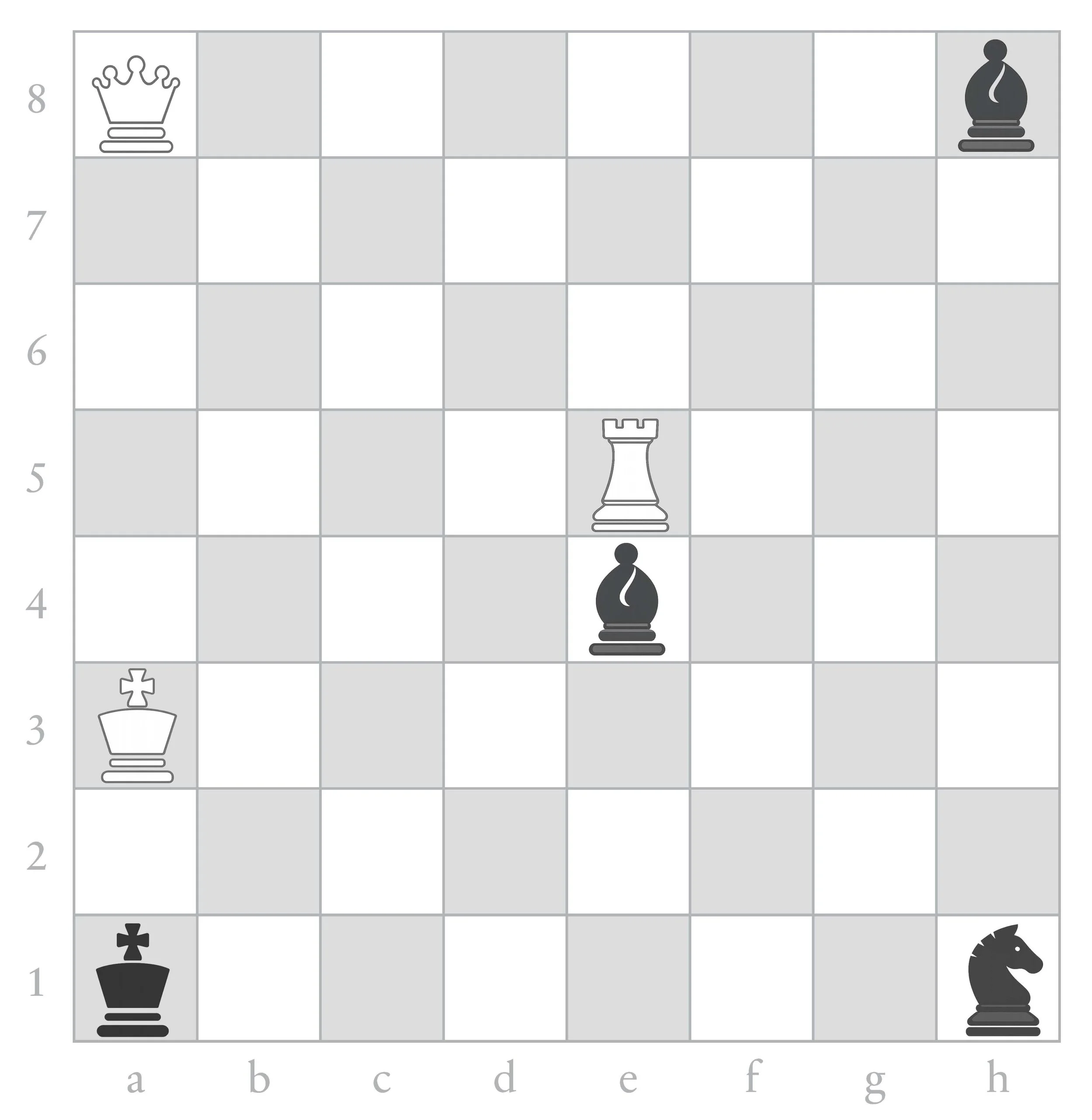
Puzzle composed by Hermann Feodor Lehner (1873).
Submit your move:
Puzzle × Post is an experiment in playing chess by mail.
*Replies by post will be sent to the first fifty submissions.
Those who complete the Puzzle × Post™ by submitting a move above and replying to the move card they receive by return mail will be invited to be recognized as Correspondents of The Correspondence Chess Company, granting early access to future releases, special editions, and discounts.
How it Works
Submit your move.
An envelope arrives by post including Black’s reply and a card to return the mate. Postage paid.
If you checkmate, you’ll receive confirmation and an invitation to be recognized as a Correspondent of the The Correspondence Chess Company.
The Correspondence Chess Company
West Hartford, Connecticut
Algebraic notation (e.g., e4, Nf3):
In correspondence chess, each move sent to one’s opponent is written in algebraic notation.
Algebraic notation is the standard method of recording chess moves. The board is described from White’s point of view.
Vertical columns (files) are labeled a through h from left to right. Horizontal rows (ranks) are numbered 1 through 8, ascending toward Black.
Each square is identified by a file letter followed by a rank number (e.g., e4). Each piece is identified by an uppercase letter: K for king, Q for queen, R for rook, B for bishop, and N for knight. Pawns are not abbreviated.
Moves are recorded by noting the piece and its destination square (e.g., Be5). Pawns use the destination square alone (e.g., c5).
Captures are marked with an x before the destination square (e.g., Bxe4). For pawn captures, include the file of departure (e.g., exd5). En passant is written exd6 e.p.
Special Moves
A pawn promotion is recorded by adding = and the letter of the promoted piece (e.g., e8=Q). Castling is recorded as O-O for kingside or O-O-O for queenside. A check is indicated by adding +, and checkmate by adding #. The result of the game is entered as 1–0 (White wins), 0–1 (Black wins), or ½–½ (draw).
Disambiguation
When two identical pieces can move to the same square, additional detail identifies the moving piece. The file or rank of departure is added after the piece abbreviation to clarify (e.g., Rae1, R3d3). When necessary, both file and rank are included (e.g., Qc2h7).
Recording the Game
Write White’s move on the left and Black’s move on the right of the same numbered line. Record each move clearly and in sequence. At the conclusion of the game, enter the result.
Etiquette
Write clearly. Respond promptly. Play with courtesy.